I.
You’ve just spent a balmy evening wandering the local Christmas night
markets. The atmosphere has a telltale buzz and you have come alone, but that’s
okay because you know you’ll bump into lots of people you know—which you do.
The whole town has come to the mall, it seems; the anticipation of the lighting
of the Christmas tree too much excitement to bear for the children who dart
about in painted faces and festive colours. Stallholders proudly display their
best wares. In amongst the regular stalls are the one-offs—the crafters busily
making special goodies for their once-a-year market outing. Aromas waft through
the crowd; hot cinnamon donuts and curry and potato twisters and fish tacos
weaving through the families with the toddlers sitting atop their fathers’
shoulders and the mothers pushing a pram and holding the sticky five-year-olds’
hands. Mingling with the chatter are Christmas carols from the choir at one end
of the mall and upbeat funk played by the band in the central gathering point.
Somewhere down the other end, a brass band belts out old favourites.
You try to decide on something to eat, or maybe something to drink and
oh! There’s so-and-so, you haven’t seen them for ages, you must go and say
hello and then you forget that you’re mildly hungry and a bit thirsty because
whilst it’s a lovely temperature now, you rode your bike here and it is still
probably 30 degrees.
Wandering back towards the centre of the mall, where the band plays
electro-funk (the likes of which you haven’t heard since you moved here from a
big city almost two years ago), a small crowd gathers and taps their feet to
the buoyant rhythm. In front of the stage, a child is dancing, and then a woman
jumps up too, arms in the air and hips side-to-side to the beat. A granny with
brightly patterned skirt and hair loose, joins her, bare feet shuffling around
on the paved ground.
You smile and watch and the band belts out a synth solo and the streaky
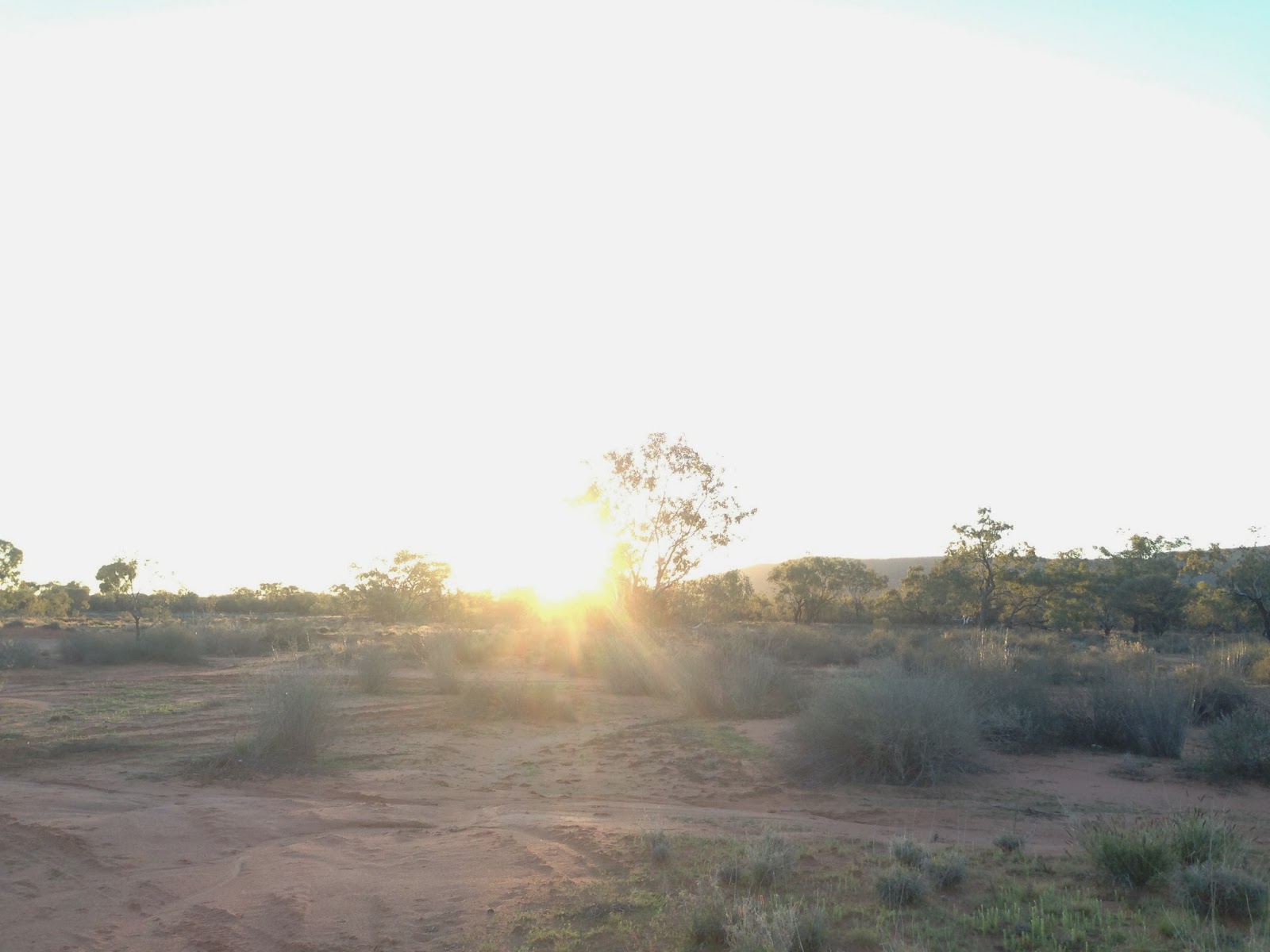
clouds turn pink in the sky behind and you breath in deeply the clear desert
air.
II.
You begin the short ride home on your one-geared bicycle. Waiting on the
footpath for the traffic lights to change, an elderly woman approaches you. ‘Hello
lady,’ she says to you in the familiar local way of speaking. ‘You help me?’
You’ve been asked this before. Sometimes it’s just a simple request for
the time. You are out the front of a pub, so you are expecting a request for
two dollar please, lady.
This time, the woman opens her hand in front of you. You’ve given coins
to people on the street before and you know you’ve got a tenner, probably a
couple of dollars in coins, in your wallet. Your bag sits in the wicker basket
on your handlebars.
Inside her hand is a fifty-dollar note.
‘Buy me beer?’ She asks you.
You can smell on her breath she has already been drinking. It’s not
late; the sun has only just dipped behind the range. She is barefoot with her
hair down, like the granny dancing in the mall.
‘No, sorry, no,’ you say, as the traffic lights change.
‘She humbuggin’ you?’ A man, who has just walked out of the pub to cross
the road, asks you.
‘It’s okay,’ you mumble as you stand on the pedals and cross the road.
III.
You cycle over the causeway that stretches the width of the sandy river.
To your left is a footbridge, the only way to get across when it rains and the
river rages in flood. You love the way the air is cooler riding along here at
night. You don’t always wear a helmet when you ride here (although, you wouldn’t
dare to ride in your former city without a helmet) and the air licks refreshingly
around your face and hair.
You hear the man’s question again in your head, she humbuggin’ you? and
the woman’s dark hands opening to reveal bright palms and the yellow fifty.
You’d said it was okay.
You’d said no, sorry, no.
You wonder whether you would have responded differently if it were a
different place, a different person, a different context.
Here, in Alice Springs, things are different. You’ve learnt that.
IV.
You’ve seen the long lines of people, feet clad with Kmart slip-ons or
thongs, the occasional pair of cowboy boots, jeans, stockman shirt and
wide-brimmed hat amongst the shorts and mismatched colourful patterns.
It’s the eleven-o-clock line, which then becomes the two-o-clock sprawl
as the animal bar closes and the drinkers spill out of the door, across the
street and onto the grassy riverside park.
Then, the lines of taxis arrive and you see them going around the block
and into the drive-through bottle-o with two-o-clock drinkers in the back.
V.
Green and gold are the colours of the zinc cream spread across the
cheeks of children as they splash through surf and sand along the coastlines
which seem so far away from here.
Green and gold are the colours of the empty cans strewn along the river
sand. Sparkling glass is littered amongst the aluminium and you have to keep an
eye out for the glistening shards that puncture your tyres, if you’re not
careful.
VI.
You have become acutely aware of living with contradictions, here in the
Territory. A divide exists. A sense of the ‘other’. A place where privilege
crosses the bridge that disadvantage has spent the night drinking beneath and
now lays, passed out in the dust and sand. Perhaps a morning walker passes by,
almost pausing until the groan of drunken stupor indicates life, or some morsel
of it. Perhaps there’s no rise and fall of the chest, and there’s sticky deep
red oozing from a wound and a jogger catches glimpse and is annoyed to be late
for work after waiting for the police to arrive.
It’s a core social value, you’ve heard the Chief Minister say of the grog.
His words echo in your head:
‘This is our lifestyle. This is the way we live.’
You are acutely aware of your comfortable home and comfortable life and
comfortable job as you hear the noisy squabble of river drinkers wafting on the
summer evening breeze. You might open a stubby of beer, the type with labels
that look hand-drawn and names that remind you of the pubs you used to drink in
before here, before now. You’ll take a sip and wonder if this is the lifestyle
that the Chief Minister meant. Or is it the lifestyle of the others who wait with
their children with matted hair and bare feet outside the bar in the mornings?
This is the way
we live.
We live.
We.
VII.
Sometimes, there is a body found in the river, or maybe near a town
camp. Sometimes, it’s a woman they find, battered by the heavy blows of her
husband, or maybe pierced by the angry knife wounds of her cousin-sister. You
know that this is one of things that make it different; that for these women,
the chance of experiencing this intimate violence is so much more likely than
it is for you and those like you. Often rage is fuelled by grog but spurred on by
something deep within, the sense of profound and raw grief, the loss of the
intangible and the loss of land and the fragmentation of culture and the grog,
yes the grog.
The women with bandaged arms and puffy lips who wander through the mall,
offering up a painting on a scrap of canvas, hoping for the curious American
tourists to pull a twenty dollar note out of their fanny-pack and make the
exchange. Twenny bucks for a painting by a real aborigine, they’ll tell their
friends back home.
This is the way
we live.
VIII.
One day, you see a woman walking completely naked down the path that
runs alongside a busy road. It’s the weekend and cars are hastily doing the
Saturday sports drop-offs. Girls in netball dresses walk in clusters, covering
their mouths as they stare at the sagging breasts and exposed pubic hair.
‘No shame!’ One girl calls out boldly before collapsing back into the
collective fits of incredulous laughter at the woman’s exposed body.
She walks slowly, intently, barefoot (bare everything) and deliberate.
No one follows, no one stops her but everyone stops to look as she passes.
You wonder what has happened to her, where her clothes are, who she was
walking away from or who she was walking towards.
This is the way
we live.
IX.
‘All the boys are ganging up on me,’ she says—or is quoted as saying, you’re
only half listening, or reading perhaps—a woman with neat blonde hair and
oversized pearls nestled between glistening gold links. There’s a by-election,
the kind of excitement that a town of this size thrives on, and there are four
male candidates jostling alongside her hoping to join the town council for the
remainder of the term left vacant by the councillor who doesn’t really live
here anymore (but was planning to open an escort agency here, at any rate).
You see the newspaper headline, it’s she versus them, the poor girl
against all the boys, a pantomime of gender taking place in rhetoric and on
radio waves.
You listen as you strain to hear the reasons, the commitments, the
promises of her campaign, but mostly you hear that she’s a woman and between
the lines you hear that that’s enough. Between the lines you see the alignments
and positionings as the pink how-to-vote cards are passed out on the day.
You think back to voting day and wonder if the lady who stopped you to
buy her beer would understand this pearl-clad struggle, being picked on by the
men, and thinking that she didn’t have a chance.
You realise she probably didn’t even vote.
She probably didn’t even have a chance.
This is the way
we live.
X.
You are pedalling alongside the river now, now that you’ve crossed it
and left the town and its fireworks and Christmas carols behind you. It’s
become dark since you crossed the road and left the woman there holding her
fifty. You imagine she shuffled on, around the corner perhaps to where people
were milling outside the pub or sitting with their friends and dining, al fresco,
on the pavement.
Did someone else help her, like she asked? Buy her a case of VB in cans,
or maybe cheap white wine, the sour liquid trapped inside brittle bright blue
glass that shatters on the bike path?
Sometimes at night-time there’s a siren, sometimes you just wake and see
the news of a body found in the river or as you walk you see a cluster of cheap
plastic flowers on the side of the road or your tyre deflates from a shard of
glass that pierces through its rubber walls.
The catchy electro-funk with its rhythmic energy plays in your head and
you might even forget that you said ‘No, sorry, no.’
This is our lifestyle. This is the way we live.
We.